

The Egyptian pyramids have been standing for over 4,000 years. Built on solid and exceptionally precise foundations, they have survived earthquakes, natural erosion, and human damage.
Building your financial plan on equally strong foundations can help you weather any unexpected storms ahead.
Countless forces can throw your financial plan off balance. But, with suitable protections, you could build a financial planning pyramid that stands firm through life’s twists and turns.
Read on to discover the unexpected events that could disrupt your financial plans and how you can strengthen your financial foundations.
Protection is the foundation of your financial plan
The financial planning pyramid consists of four layers, building from protection to savings, investments and pensions.
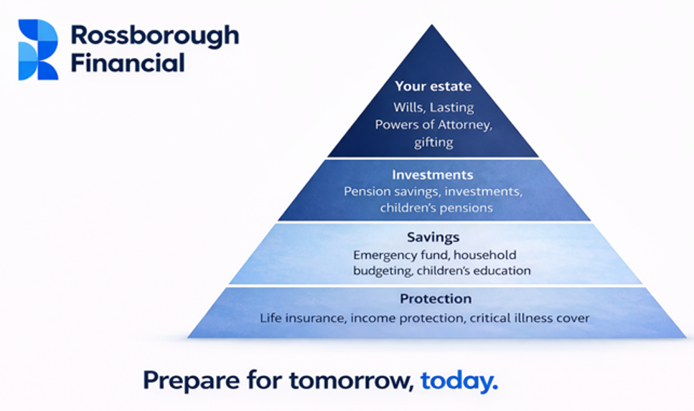
When thinking about the future, it can be easy to focus on the middle layers. You might think of long-term financial planning as growing your wealth through budgeting, saving and investing, and retirement planning.
Read more: Where your pension fits into the “financial planning pyramid”.
Of course, these areas are important. But if they’re not underpinned by comprehensive protection suited to your needs, you could build your wealth on unstable foundations.
Here are three scenarios that could disrupt your financial plan without the right provisions in place.
1. Becoming unable to work due to long-term illness or injury
If you or your partner became unable to work due to illness or injury, how would your family’s finances be impacted?
No one likes to think about the possibility of becoming unwell. But by getting the right protections in place, you could help limit the financial damage health problems can cause.
To manage loss of income in the event of illness or injury, you might consider taking out cover.
- Income protection: Replaces a portion of your lost income while you’re unable to work, with monthly payments starting after a waiting period.
- Critical illness cover: Provides a one-off lump-sum payment if you’re diagnosed with one of the policy’s defined illnesses.
You can choose one type of cover, or both, depending on your needs and priorities.
In some cases, your employer may offer income protection or critical illness cover as a benefit of employment. So, it’s worth checking what cover you already have, reviewing both the amounts and length of time this would be paid, before determining if you require any further protection.
With suitable protection in place, you have peace of mind that your finances will be taken care of if you become unable to work due to illness or injury. That way, you can focus on your health and wellbeing instead of worrying about money.
2. An unexpected bereavement
In the event you unexpectedly pass away, how would your family get by financially? Equally, would you be financially stable if you lost your partner?
Tip: Start by reviewing your current liabilities – such as your mortgage, outstanding loans, education costs, and essential living expenses – to understand how much financial support your family might need. While your employer’s death‑in‑service benefit may cover some of this, additional protection is often needed to ensure your loved ones are financially secure.
This isn’t an easy thing to think about. But, without planning for the worst, your family could be exposed to financial risks.
Fortunately, with suitable life cover in place, surviving family members can manage the loss of income after an unexpected death.
There are two types of life cover to choose from:
- Whole of life cover: You’re covered for the rest of your lifetime, provided you keep up with premium payments. Your chosen beneficiary will usually be entitled to a fixed lump sum when you die, with the amount agreed when you take out the policy.
- Fixed-term cover: Your cover lasts for a defined period. You might choose to have your payout fixed at a certain amount or decrease over time. For example, you might opt for a decreasing payout to align with an outstanding mortgage.
The options for life cover can be confusing. But by identifying suitable protection for your needs, you can rest assured that your family’s finances will be taken care of if something happens to you.
3. Unexpected expenses
Sudden expenses can crop up at any time. Whether your boiler breaks, your car needs repairs, or a loved one needs financial support, you can find yourself in urgent need of cash at a moment’s notice.
In some cases, you might find your assets aren’t easily accessible. They could be tied up in investments, held in a fixed-term savings account, or locked away in your pension.
By setting aside an easily accessible emergency fund, you can prepare for unexpected expenses. That way, you can reduce the likelihood of needing to sell assets and investments or rely on expensive borrowing to cover urgent costs.
As a rule of thumb, it’s wise to have around three to six months’ expenses set aside in an emergency fund. When supplemented by suitable protection, this can prepare you for any unexpected costs life throws your way.
Build your financial plan on solid foundations
It can be easy to forget about preparing for the unexpected when you’re focused on growing your wealth. But with the right plans in place, you can help ensure you’re building your future on solid foundations.
For more information, and to discuss how we can support you please contact the Rossborough Financial Protection team email enquiries@rfsl.co.uk or call 01534 502000 in Jersey or 01481 747940 in Guernsey.
Please note
This article is for general information only and does not constitute advice. The information is aimed at individuals only.
All information is correct at the time of writing and is subject to change in the future.
Note that life insurance and financial protection plans typically have no cash in value at any time and cover will cease at the end of the term. If premiums stop, then cover will lapse.
Cover is subject to terms and conditions and may have exclusions. Definitions of illnesses vary from product provider and will be explained within the policy documentation.
Rossborough Financial Services Limited is regulated by the Jersey Financial Services Commission under the Financial Services (Jersey) Law 1998 and licensed by the Guernsey Financial Services Commission.