

From taking out protection to saving for retirement, there’s a lot to consider when planning your finances.
With so many moving parts to consider, it can be hard to know where to start, what your priorities should be, and how it all fits together. Retirement planning, for example, is just one part of your financial strategy. To be effective, it needs to align with your wider finances.
The financial planning pyramid is a simple framework that can help you visualise how your finances are structured and identify priorities for protecting, growing, and sharing your wealth.
Read on to learn more about the financial planning pyramid and where your pension fits into the bigger picture.
The four levels of the financial planning pyramid
The pyramid consists of four levels, starting with a strong foundation and building upwards to improve your financial security, grow your wealth, and potentially leave a legacy to loved ones or charity.
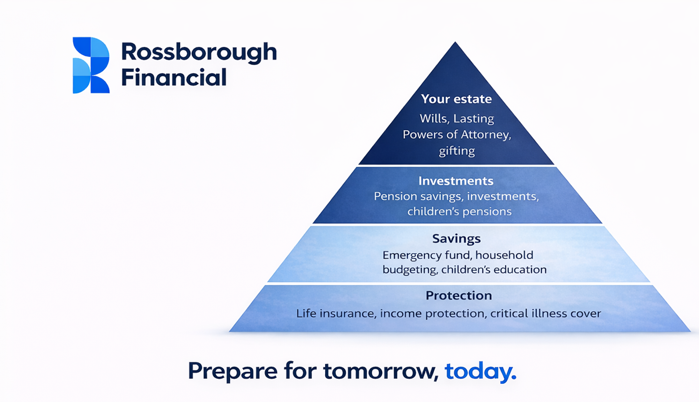
The pyramid isn’t strictly linear. Indeed, wills are the cornerstone of effective financial planning, offering vital protection for your loved ones and your assets when you pass away. As such, it’s often wise to get a will in place in the early stages of financial planning.
However, by using the framework as a guide, you could make more informed, strategic decisions about your money, improve your financial security, and gain the confidence you need to set more funds aside for your future.
Now, let’s break down the pyramid from the foundations to the pinnacle, and the key considerations for each level.
1. Protecting your wealth against the unexpected
Without a secure base, unexpected events can throw a financial plan off course.
That’s why it’s important to have the right protection in place. Ultimately, protection means having a plan for handling a sudden loss of income and ensuring your family is financially prepared for all eventualities.
In some cases, your employer may offer some cover as an employee benefit. As such, it might be worth starting by assessing what protection you already have in place and identifying any gaps.
The specific elements required will depend on your unique circumstances and priorities, but might include:
- Life insurance: Cover for a fixed term or whole of life, which pays out a lump sum to your chosen beneficiary upon your death.
- Income protection: Replaces a portion of your lost income with regular payments should you become unable to work due to illness or injury.
- Critical illness cover: Pays out a lump sum in the event you’re diagnosed with one of the policy’s specified illnesses.
Having these building blocks in place can give you the confidence you need to start focusing on other areas of your financial plan.
For example, with pension funds largely inaccessible until later in life, it’s not uncommon for people to put off retirement saving out of fear that they will need the funds sooner. By protecting yourself against the unexpected, you could invest more in your pension without fearing a sudden change of events.
2. Saving for your short-term needs
Next, you might focus on saving for your upcoming or immediate financial needs.
This can include building an emergency fund to prepare for unexpected costs like property or car repairs, and saving for short-term expenses, such as holidays.
It also involves taking control of your day-to-day expenses by creating a household budget and identifying opportunities to reduce spending. By increasing your disposable income, you can free up more funds to start saving for your long-term future.
3. Investing to achieve your long-term goals
When your immediate and short-term needs are met, you might start thinking about the future. This is where retirement planning fits into your bigger picture.
As part of this, you might consider:
- Investing more to grow your wealth over a prolonged period
- Paying more into your pension pot
- Building wealth for your children, potentially through a savings account or children’s pension.
Once you have strong financial foundations and a clear budget to make the most of your excess income, adopting a ‘pay yourself first’ approach can be an effective way to save. By setting aside a fixed amount each month, you can build your future savings with greater consistency and confidence.
Of course, it can still be difficult to determine your priorities at this level. It can be helpful to define your vision for the future and weigh the risks and returns of your different options before deciding how to divide your funds between pensions, savings, and investments.
4. Leaving a legacy
Finally, you might start considering how to share your money with loved ones or charities.
Having a will in place is the cornerstone of financial planning. It’s a crucial step to ensure your chosen beneficiaries receive their intended inheritance when you pass away. Although it’s at the “pinnacle” of the financial planning pyramid, that isn’t to say you should leave it until last. Rather, it might be wise to make a will early and update it as your wealth grows and circumstances change.
Likewise, you might consider registering Lasting Powers of Attorney (LPA) to ensure your loved ones can access key financial assets and make decisions about your health should you lose mental capacity.
But estate planning isn’t just about what happens when you pass away or become unwell. It also includes giving gifts in your lifetime, which can offer loved ones a financial boost earlier in their lives and allow you to see them enjoy it while you’re still here.
While some exceptions might apply, such as supporting a family member during an emergency, many people will look to secure their own financial future through saving, investing, and building a pension pot before sharing with loved ones.
Build your holistic financial plan on solid foundations
Retirement planning shouldn’t be viewed in isolation. It’s part of a much bigger financial picture, consisting of multiple priorities, goals, and considerations. By creating a holistic financial plan, you could help ensure your current and future needs are met.
To get started, you might consider assessing your protection needs and making a will. That way, you can rest assured that your loved ones are financially protected against the unexpected as you grow your wealth.
You can email enquiries@rfsl.co.uk or call 01534 502000 in Jersey or 01481 747940 in Guernsey for more information.
Please note
This article is for general information only and does not constitute advice. The information is aimed at individuals only.
All information is correct at the time of writing and is subject to change in the future.
Please do not act based on anything you might read in this article. All contents are based on our understanding of tax legislation, which is subject to change.
The Jersey or Guernsey Financial Services Commissions do not regulate estate planning, cashflow planning, tax planning, Lasting Powers of Attorney, or will writing.
A pension is a long-term investment not normally accessible until 50. The fund value may fluctuate and can go down, which would have an impact on the level of pension benefits available. Past performance is not a reliable indicator of future performance.
The tax implications of pension withdrawals will be based on your individual circumstances. Thresholds, percentage rates, and tax legislation may change.
The value of your investments (and any income from them) can go down as well as up and you may not get back the full amount you invested. Past performance is not a reliable indicator of future performance.
Investments should be considered over the longer term and should fit in with your overall attitude to risk and financial circumstances.
Note that life insurance and financial protection plans typically have no cash in value at any time and cover will cease at the end of the term. If premiums stop, then cover will lapse.
Cover is subject to terms and conditions and may have exclusions. Definitions of illnesses vary from product provider and will be explained within the policy documentation.
Rossborough Financial Services Limited is regulated by the Jersey Financial Services Commission under the Financial Services (Jersey) Law 1998 and licensed by the Guernsey Financial Services Commission.