

As an investor, you likely feel comforted watching the stock market grow. In the past few years, you may have seen headlines about record-breaking highs as leading businesses – many of them in the tech sector – posted impressive earnings. But underneath these numbers, a quieter story has been playing out for decades. One that investors ignore at their peril.
At several points throughout market history, a significant percentage of the gains have been generated by a small number of companies. History demonstrates that this level of concentration typically ends badly.
We are living through another such moment. This time, a single company sits at its centre.
A market held aloft by a few
When the stock market performs strongly, it is easy to assume the rally is broad-based, with all companies performing well. However, that is not always the case.
Narrow markets, in which a small cluster of companies accounts for most gains, are a recurring feature of bull runs (a prolonged period of sustained stock market rises). This concentration is also a regular precursor to some of the most damaging drawdowns in financial history.
Figures from MoneyWeek show that, as of May 2026, tech company Nvidia held a 7.73% weight in the S&P 500. This is more than the entire energy sector, utilities, and the combined weight of dozens of companies most investors would consider substantial.
Apple sat behind Nvidia at 6.41% and Microsoft at 4.57%. Those three companies alone accounted for almost 19% of the entire index. The top 10 companies held about 39% of the total index value.
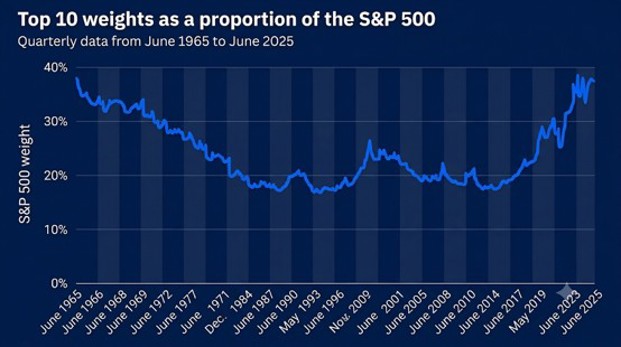
This is an extreme rarely seen in living memory, aside from two very specific, instructive historical episodes, as demonstrated in the following graph.
It shows the proportion of the total value of the S&P 500 made up by the top 10 companies, from June 1965 to June 2025.
Source: S&P Global
As you can see, the high concentration we are currently seeing is not a regular feature of stock market indices. Instead, it is a situation that emerges in specific conditions and affects investors in every market.
When returns are this concentrated, the fortunes of the broader market are tied to the performance of a handful of companies. This is a risk that deserves serious attention, and looking back at similar situations can give us an insight into what the future could hold.
The Nifty Fifty: The first warning
In the late 1960s and early 1970s, a group of around 50 blue-chip stocks became known as the “Nifty Fifty”.
Companies like IBM, Xerox, Polaroid, Coca-Cola, Disney, and McDonald’s were considered “one-decision” stocks – businesses so strong that investors only needed to make one choice to buy and hold forever. The logic appeared sound as these were America’s finest companies, steadily growing, reliably profitable, and dominant in their industries.
As a result, investors piled in. Figures from AJ Bell show that in the early 1970s, the top 10 companies accounted for roughly 30% of the entire index.
What’s more, Fundsmith reports that the average price-to-earnings ratio – the cost of the stock compared with the earnings per share – of the Nifty Fifty reached 45.2. This was more than double the broader market’s 19.2 average multiple.
Although the stocks were expensive, believers argued that quality deserved a premium, and the narrative of unstoppable growth prevailed.
However, the economic cycle eventually shifted as inflation surged, leading to a bear market – a period of prolonged market falls – in 1973/74.
Coca-Cola’s share price peaked in January 1973 and then fell 66% over the next 22 months. Disney reached a high at the same time but had dropped 82% by October 1974. Johnson and Johnson experienced a loss of 42% between January 1973 and October 1974.
The highest-valued companies, almost without exception, performed the worst. The top half of the Nifty Fifty materially underperformed the broader S&P 500 not just during the crash, but across the following 30 years.
The “one-decision” stocks turned out to be very poor choices indeed. Not because the businesses were fraudulent or fundamentally broken, but because the market had significantly overvalued them.
The dotcom echo
History repeated itself at the turn of the millennium. Following the recession of the early 1990s, a new generation of technology companies – including Microsoft, Cisco, Intel, and Oracle – moved to the top of the market. Their growth was fuelled in part by genuine innovation but also by excitement about the potential of the internet.
While the growth was real, the valuations were far too optimistic.
By the year 2000, according to AJ Bell, the top 10 companies in the S&P 500 represented 27% of total market capitalisation.
Investors were filled with confidence, but then the bubble burst.
Figures from MoneyWeek show that after increasing by an impressive 87.7% between October 1999 and March 2000, the value of the NASDAQ had more than halved by December 2000.
Many companies collapsed. Even genuinely great companies that survived, such as Amazon or Microsoft, became bad investments when purchased at excessive prices during a period of extreme concentration.
This demonstrated that, while the tech sector was a potentially lucrative area to invest in, price always matters, and a market propped up by a small number of names is uniquely fragile. Crucially, the higher the concentration, the more significant the redistribution when the cycle eventually turns.
The Nvidia moment
This brings us to today, and to Nvidia.
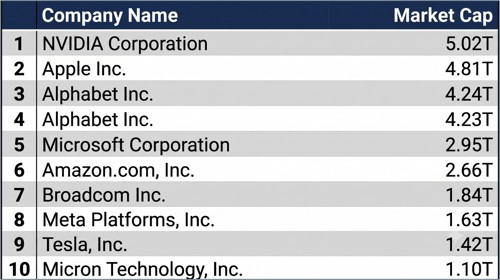
In the space of just a few years, Nvidia has undergone one of the most impressive periods of growth in stock market history. A company that was valued at a fraction of Apple and Microsoft not long ago is now, as of July 2026, worth over $5 trillion.
Nvidia is the world’s largest company by market capitalisation, closely followed by Apple. It controls a dominant share of the AI semiconductor market, supplying the graphics processing units that power virtually every major artificial intelligence model on earth.
Source: Stock Analysis (22/07/2026)
The investment case is not without merit. Nvidia’s revenue growth has been exceptional, and its dominance in AI infrastructure is real.
But here lies the danger that history warns us of. The Nifty Fifty companies were also genuine leaders in their respective fields. Equally, the dotcom era’s technology giants were building something real.
In both cases, the problem was not the quality of the underlying business. It was the degree to which the entire market’s fate had become bound to the continued outperformance of a tiny number of companies. When the mood shifted, or the numbers disappointed, there was no cushion, and the narrow base meant the fall was steep.
The dangers of a fragile market
The conditions that lead to concentrated markets are well understood, but they are often overlooked during a bull run. Rising prices draw more capital towards the leading companies, and that investment pushes prices higher still.
Valuations stretch, and narratives emerge with investors believing that “this time is different”, “these companies are too important to fail”, or “the growth justifies the price”.
As a result, entire market indices become dependent on the continued expansion of a tiny cohort.
According to the CFA Institute, historically, the bottom 490 stocks in the S&P 500 have outperformed the top 10 in 69% of five-year rolling periods. The current valuation gap between the top 10 and the rest of the market is at an extreme not seen since the dotcom peak.
The risks that could unsettle today’s narrow market are not hypothetical. An earnings disappointment, a regulatory intervention in AI chip exports, or a rival technology that erodes GPU dominance could all damage Nvidia’s value.
This could ripple through markets in a way that a more broadly distributed rally simply would not.
What history demands of investors
None of this means the AI revolution will collapse. The question is whether the price the market is charging for tech companies, and the degree to which everything else depends on them, has moved beyond what the fundamentals can sustain.
History does not guarantee that this ends badly. But, as we’ve seen, there is a consistent record of what tends to follow periods of market concentration at this level.
The prudent investor – whether active or passive, institutional or individual – does not need to panic. But they do need to understand the structure of the market they are participating in. Knowing that today’s gains are being driven by a narrow band of companies is not a reason to sell. It is a reason to think clearly about risk, valuation discipline, and the historical pattern of what comes next.
The road is narrow. And the narrower it gets, the more carefully investors of every kind ought to watch their step.
Please note
This article is for general information only and does not constitute advice. The information is aimed at individuals only.
All information is correct at the time of writing and is subject to change in the future.
The value of your investments (and any income from them) can go down as well as up and you may not get back the full amount you invested. Past performance is not a reliable indicator of future performance.
Investments should be considered over the longer term and should fit in with your overall attitude to risk and financial circumstances.
Rossborough Financial Services Limited is regulated by the Jersey Financial Services Commission under the Financial Services (Jersey) Law 1998 and licensed by the Guernsey Financial Services Commission.