

Risk and investing go hand in hand. One cannot exist without the other.
However, certain strategies – including “pound cost averaging” – can help reduce the risk that your investments are exposed to.
Pound cost averaging involves making regular, fixed contributions to your investment portfolio to smooth out the cost of purchasing shares during periods of market volatility.
Continue reading to learn more about how pound cost averaging works in practice and its key benefits, as well as three savings habits that can help you invest regularly.
Pound cost averaging uses regular, fixed payments to balance risk
Unlike investing a one-off lump sum, pound cost averaging involves making regular, fixed investments over a long period of time.
When investing a lump sum, you purchase units at a single price. You may get lucky and buy into the markets when prices are low, meaning you have greater growth potential. However, the opposite could happen, and you may invest when prices are high.
Instead, pound cost averaging smooths out the effects of market volatility by investing regularly. This means you buy fewer units when prices are high and more when prices are low, encouraging stable and secure growth for your wealth.
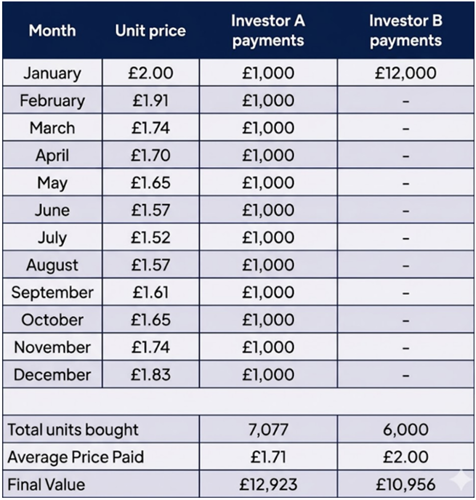
The table below shows how this works in practice.
Source: Royal London
In this example, Investor A invests £1,000 each month over the course of a year, while Investor B makes a single lump sum investment of £12,000 in January.
Over time, the market fluctuates, and the unit price of the investment ends up lower by the end of the year.
Because of this, Investor B suffers a loss of £1,044, while Investor A makes a profit.
By purchasing fewer units when prices were high and more when they were low, Investor A reduced the average cost of each unit. This softened the effects of market volatility on their investments and allowed them to achieve stable growth.
In addition to spreading risk, pound cost averaging takes emotion out of investing and helps build savings habits
As we have explored, the primary benefit of pound cost averaging is to help spread investment risk during periods of market volatility.
However, there are also several behavioural advantages to this strategy.
For example, pound cost averaging can help prevent investors from panic-selling during stock market turbulence by eliminating emotion.
This is because pound cost averaging is a long-term strategy that accounts for volatility. Rather than moving your investments around in response to market dips, which might solidify your losses, you can continue making the same investment each month.
Additionally, pound cost averaging can help you develop or refine healthy saving habits.
3 savings habits that help accommodate a pound cost averaging strategy
Here are three strategies to help you implement pound cost averaging into your financial plan.
1. Build a budget
A budget is a sensible way to organise your income, expenses, and savings regularly (usually month to month or in line with when you receive your regular income).
How much you devote towards saving, spending, and essential costs depends on you. However, a good starting point is the 50/30/20 rule, which dictates that:
- 50% of your income is for essential costs, like mortgage payments, rent, and household bills
- 30% of your income is for personal spending, whether that’s eating out, shopping, or a holiday
- 20% of your income is saved or invested, including your pound cost averaging payments and any other regular contributions you make towards your future goals.
Note that these ratios aren’t fixed, and it’s important that you create a budget that suits your individual needs and expectations.
2. Set savings goals
Motivation is crucial for developing healthy savings habits. Savings goals can give you that necessary push.
These might be short-term objectives, such as an overseas holiday or a new car. They can also be for long-term goals, including home renovation or an earlier retirement, which pound cost averaging could help you achieve.
3. Pay yourself first
Paying yourself first is a financial strategy by which you automatically and immediately dedicate a portion of your income to your savings and investments.
This occurs before any bills or discretionary spending and treats savings and investments as a mandatory expense. If most of your fixed direct debits leave the account on the 28th, consider a monthly investment contribution the day before. Doing so reduces the likelihood that you will spend this income before you save.
Paying yourself first is a behavioural strategy that prioritises your future needs. Setting up and automating regular payments for pound cost averaging can help you establish this mindset so that you meet your expectations for the future.
Summary
Market movements are unpredictable, which makes consistently “timing the market” extremely difficult. History shows that investors are often better served by focusing on time in the market instead — staying invested over the long term and accepting short‑term volatility as part of the investment journey.
By combining a long‑term mindset with strategies such as diversification and pound‑cost averaging, investors can improve their ability to manage risk and build wealth more steadily over time.
Get in touch
If you’d like to learn more about pound cost averaging and other investment strategies, please get in touch with your Rossborough Financial contact today.
You can email enquiries@rfsl.co.uk to book an appointment with your adviser. Alternatively, call 01534 502000 in Jersey or 01481 747940 in Guernsey to set up a meeting.
Please note
This article is for general information only and does not constitute advice. The information is aimed at individuals only.
All information is correct at the time of writing and is subject to change in the future.
The value of your investments (and any income from them) can go down as well as up and you may not get back the full amount you invested. Past performance is not a reliable indicator of future performance.
Investments should be considered over the longer term and should fit in with your overall attitude to risk and financial circumstances.
Rossborough Financial Services Limited is regulated by the Jersey Financial Services Commission under the Financial Services (Jersey) Law 1998 and licensed by the Guernsey Financial Services Commission.