

You will already know that the cost of living is rising – so it stands to reason that the cost of a comfortable retirement is following suit.
The difference is that, while you are working, there are usually opportunities to increase your earnings year-on-year – this is known as “accumulation” – meaning you can keep up with rising costs.
When you retire, you begin “decumulating”. In other words, you will make regular withdrawals from a finite source of assets accumulated during your working life (your pensions, investments, and cash savings), which can run out. You may also be entitled to a State Pension so it is worth checking the amount you could receive.
While you are still working, it is important to keep an eye on the anticipated cost of your retirement and plan ahead. If you don’t, you may find that you are unable to maintain the lifestyle you have become accustomed to when you stop working, especially if you want to continue living on Jersey or Guernsey.
Keep reading to discover how the cost of retirement in the Channel Islands compares to the rest of the UK, plus a few tips on how to prepare while you are still working.
Pensions UK’s Retirement Living Standards paint a picture of how much retirement costs now
Every year, Pensions UK publishes its Retirement Living Standards – a set of figures telling consumers how much it may cost to have a “minimum”, “moderate”, and “comfortable” retirement.
Although there are no figures specifically for the Channel Islands, we often have a slightly higher cost of living than London (more on this later). For 2026, the Retirement Living Standards for London are detailed below.
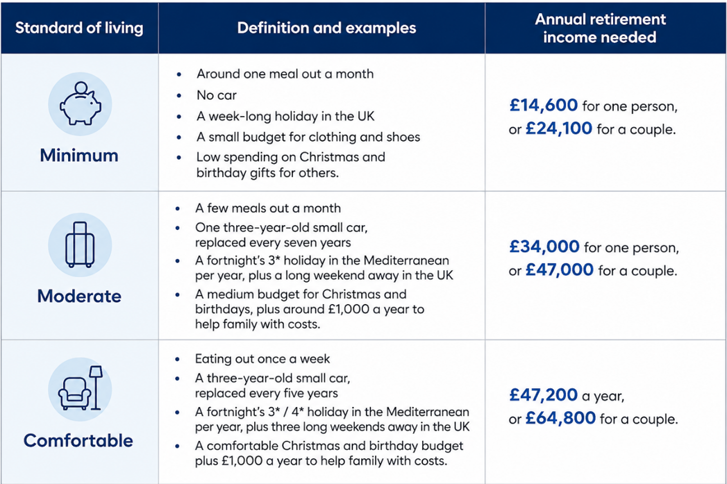
Source: Retirement Living Standards and London equivalents
If given the choice, you would probably prefer to put yourself in the “comfortable” category.
Here are a few things to note when using these figures as a guide:
- It is important to remember that these calculations are based on the 2026 figures, which are likely to rise year-on-year.
- The Retirement Living Standards don’t account for large one-off expenditures, such as a bucket list holiday or helping your child with a house deposit.
- The Channel Islands are typically a more expensive place to live than London.
It could cost around 20% more to live in Jersey and Guernsey than the rest of the UK
There is not much recent standardised research into the difference between living in the Channel Islands and the rest of the UK – but here are some figures that could guide you.
Jersey
The latest available data is from 2013, and it reveals that prices in Jersey were, on average, 20% higher than the rest of the UK.
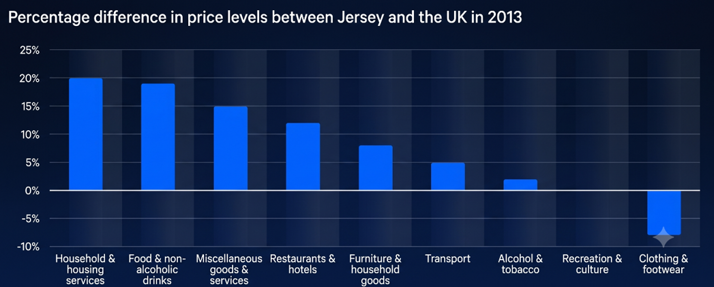
Source: Statistics Jersey
Of course, the difference may be even starker in 2026 with the significant rise in food prices over the last few years.
Guernsey
Numbeo reports that the cost of living in Guernsey, including rent, is 21.3% higher than in the rest of the UK, while My Life Elsewhere estimates it is 17.5% more expensive to live in Guernsey.
This gives you an idea of how much it may cost to retire in either location, should you wish to stay once you stop working. Our quality of life for retirees is undeniable, but it comes at a price – so now is the time to begin preparing for your retirement and the increasing cost of living.
The importance of paying attention to your pension today
Pensions UK research, published by MoneyAge, reveals that just 9% of people in the UK are on track to achieve a comfortable standard of living in retirement.
The above figures make it clear why – without careful planning, it could be hard to secure a retirement fund to provide for your lifestyle once you stop working.
As such, the importance of actively reviewing your pension savings year-to-year cannot be overstated.
Remember, even small increases to your pension contributions could make a massive difference over time. Thanks to the benefits of compounding, marginal increases today could see your pension fund rise by tens of thousands by the time you retire.
Read more: Compound interest: How “the eighth wonder of the world” could boost your wealth
Use your ZIO app to see whether you’re one of the 9% who are ready for a comfortable retirement
Guessing at your retirement readiness won’t get you far. Fortunately, the ZIO app allows you to:
- Calculate your projected future pension value based on a series of estimations
- Learn the basics of how your pension works and why making regular contributions is so important
- Check whether your imagined retirement income matches up with reality.
It is never too early to get started, so take the time to assess your retirement readiness today.
Get in touch
You can start your pension planning with the help of the tools on the ZIO app, and Rossborough Financial can provide further guidance.
You can email enquiries@rfsl.co.uk, call 01534 502000 in Jersey or 01481 747940 in Guernsey to learn more today.
Please note
This article is for general information only and does not constitute advice. The information is aimed at individuals only.
All information is correct at the time of writing and is subject to change in the future.
A pension is a long-term investment not normally accessible until 50. The fund value may fluctuate and can go down, which would have an impact on the level of pension benefits available. Past performance is not a reliable indicator of future performance.
The tax implications of pension withdrawals will be based on your individual circumstances. Thresholds, percentage rates, and tax legislation may change.
Your pension income could also be affected by the interest rates at the time you take your benefits. The tax implications of pension withdrawals will be based on your individual circumstances, tax legislation, and regulation, which are subject to change in the future.
Rossborough Financial Services Limited is regulated by the Jersey Financial Services Commission under the Financial Services (Jersey) Law 1998 and licensed by the Guernsey Financial Services Commission.